OK, so at the end of last year Volkswagen updated the 2013 seventh-generation Golf. Volkswagen always needs to ensure the Golf remains tempting to interested punters, which is why 2017 ushers in the not-so-unexpected mid-life facelift. Think of it as the Golf’s new Spring Collection.
A series of minor exterior styling tweaks, more paint options, and interior technology upgrades across the range—from the three-door and five-door hatch to the Golf Estate—are designed to appeal to our animal instincts. The Golf is offered with a seemingly vast array of engine options: three petrol and three diesel units, available in a number of power derivatives, ranging from the three-cylinder 1.0-litre 82bhp TSI petrol to the 2.0-litre 184bhp TDI diesel.
We won’t go into too much detail here; there are plenty of other motoring plebs who like to recycle the details in… detail. One note worth mentioning is that the 1.4-litre TSI petrol unit has been replaced with a 1.5-litre four-cylinder TSI engine, available in 128bhp and 148bhp outputs. If you think VW is still on the emissions fiddle, think again—the Golf is also offered as a petrol/electric hybrid (GTE) or as a fully electric e-Golf.
Almost the entire Golf range can be had with either a seven-speed DSG transmission or a six-speed manual. Prices start from around £17k and stretch to £33k—more if you go wild on the options list. VW claims to have knocked £650 off the Golf range, which conveniently means £650 to spend on optional extras. Oh Lord… they giveth and they taketh.
The updated Golf also receives a host of driver-assist technologies: Lane Departure Warning, radar-guided cruise control, emergency braking, Predictive Pedestrian Protection, and so on. The new infotainment system features gesture control—a notable first in the compact hatch market. Screen sizes range from a minimum of 6.5 inches to a maximum of 9.2 inches, depending on the model variant.
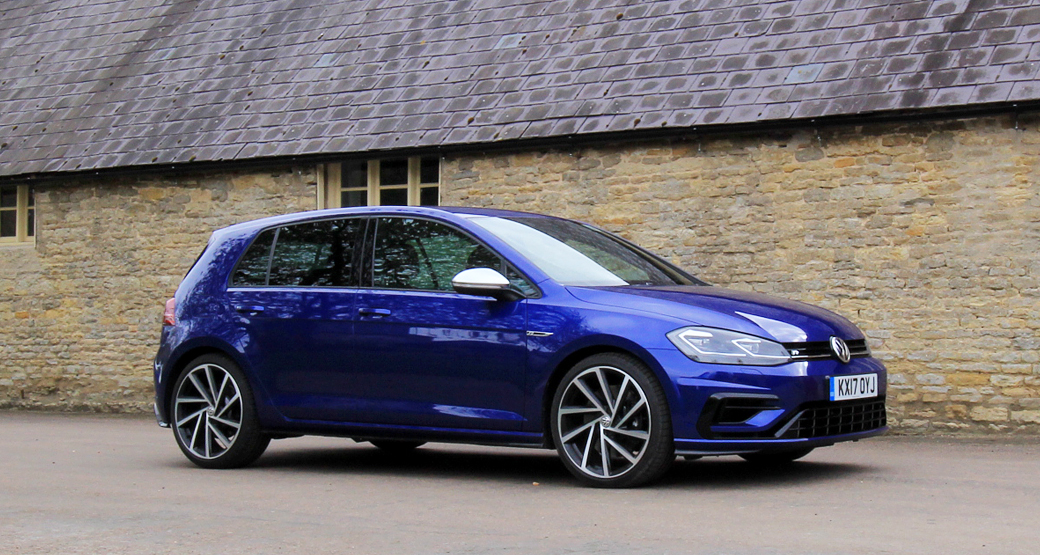
To be honest, we’re not going to give a comprehensive breakdown of trim levels or engine options. Having been invited to a VW driving event at the Woburn Sculptural Gallery, we had limited time to test our chosen one. I made a beeline straight for the Golf R—the brand’s flagship hell-raiser. It may look respectable, but this is the kind of car that doesn’t give a damn. It wants to drink more until it can take no more, and when it’s down for the count, writhing on the floor, it gets right back up and demands one more glass—before scoring a perfect 180 on the darts board.
The Golf R is powered by a 2.0-litre, four-cylinder TSI petrol engine. In standard form it delivers 226bhp, but in the Golf R it’s been tuned to spit out 305bhp and 380Nm of torque. With the seven-speed DSG, the Golf R accelerates from 0–62mph in 4.6 seconds—half a second quicker than the manual—and tops out at 155mph.
Don’t get me wrong, the 0–62mph time is quick—very quick—but it doesn’t feel devastatingly fast. Because the Golf R has so much traction and grip, combined with a stable chassis, you get a projectile that delivers speed with the calm assurance of a ninja assassin. The engine dispenses this pace with smooth authority, and there’s a crisp clarity between each automated gear shift—each lightning-fast—although downshifts can feel a little thuggish.
You get four drive modes—Eco, Comfort, Race, and Individual—which determine how much violence the Golf R is allowed to dish out. Realistically, you should leave it permanently in Race mode. This delivers maximum savagery: sharper steering, instant throttle response, and lightning-quick gear changes. However, it’s a bit too aggressive for motorway cruising, primarily because the DSG gearbox remains permanently alert and tends to downshift when you just want to waft. When it does, you hear a throttle blip, and when you really start pushing on, the cabin fills with resonant evil.
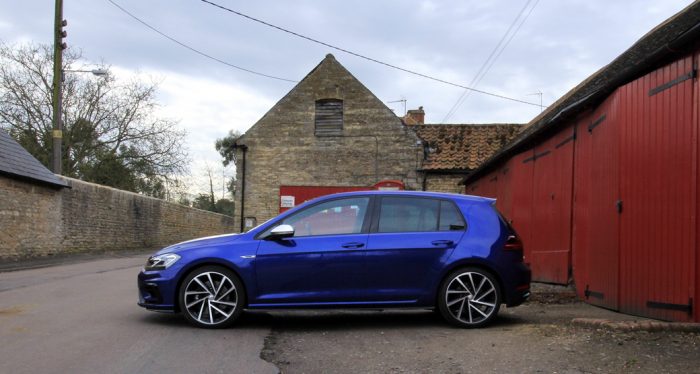
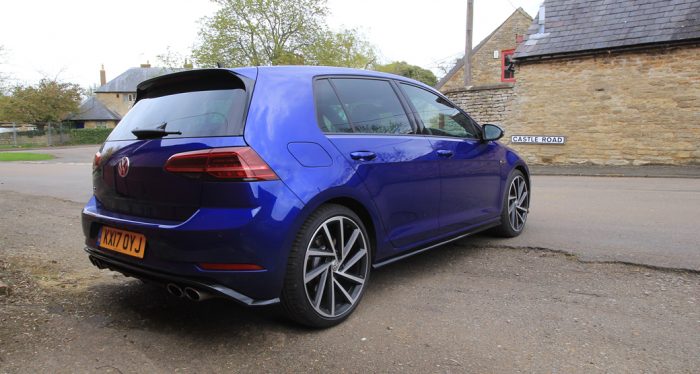
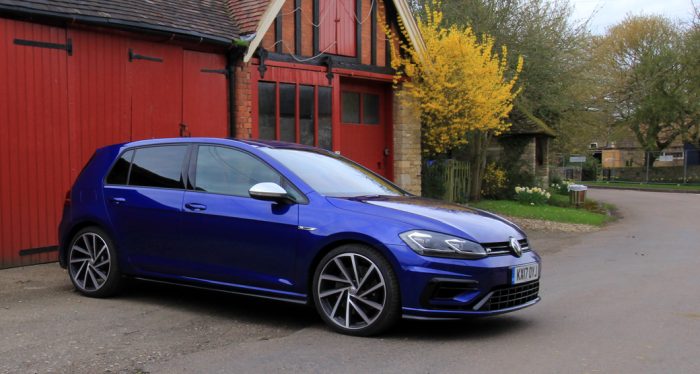
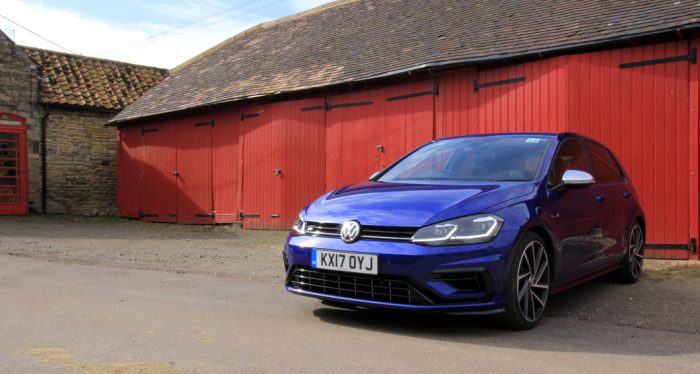
So yes, the Golf R is quick in a straight line, but you soon acclimatise to the speed. It’s the corners where things really matter—and thankfully, the Golf R ticks most of the “driving god” boxes. Two of the most important are looks and stance: the lowered sports suspension, 18-inch alloy wheels, cosmetic updates, and more aggressive bumpers combine to give the Golf R a thuggish appearance—without the gold chain.
It’s loaded with driving tech: an electronic differential, traction control, a differential lock for improved handling, and an anti-tramp function. The latter ensures full traction by telling the ESP system to stop interfering with the fun. Combine this with four-wheel drive and the Golf R has traction in abundance.
The ride is stiff, and initial turn-in feels pointy—razor-sharp at low to mid speeds—but there’s no real “magic” coming through the electronic steering wheel. This isn’t unique to the Golf R; electronic steering systems—whether in a Porsche or a Jaguar F-Type—inevitably dilute feel. Most feedback comes through the chassis, which exhibits an almost neutral balance.
Overall, the ride and handling feel measured. The rear has a hint of give, and with the steering dialled into Race mode, you can dive into corners with little fear of the Golf R ever breaking loose. Body roll is minimal, and thanks to the electronic differential, four-wheel drive system, and inherent balance, the Golf R encourages early throttle application on corner exit due to the sheer grip available.
Despite the stiff setup, the telescopic suspension keeps things well damped, resulting in a car that’s alarmingly comfortable given the savagery lurking beneath. The brakes offer excellent bite, though heavy braking from speed can cause the front end to squirm slightly.
While the Golf R is a comfortable cruiser, the steering felt a touch fidgety at motorway speeds. Like most compact hot hatches, it also lacks ultimate aerodynamic stability. Although it tracks well at high speed, you can feel the front end grow ever so slightly light. Compare it to something like a McLaren 570S—whose superior aerodynamics offer unwavering stability—and you can’t help wondering whether the Golf R should prioritise aero upgrades over segment-first gesture control.
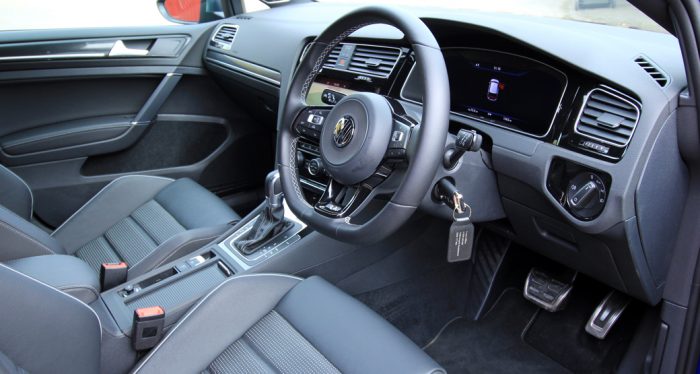
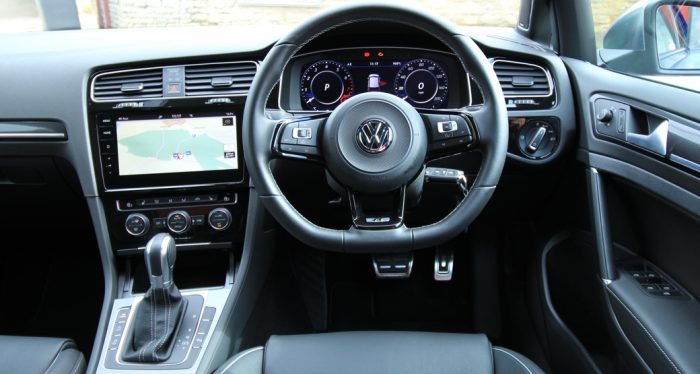
Don’t get me wrong, I like tech—especially with a mega-death sound system—but in a car built around performance, toys matter less than how power is delivered and exploited. That said, the Golf R’s interior is classy. The leather sports seats are comfortable but cost nearly £2k, and the cabin showcases classic Germanic build quality. These days, you don’t feel short-changed sitting in a Golf.
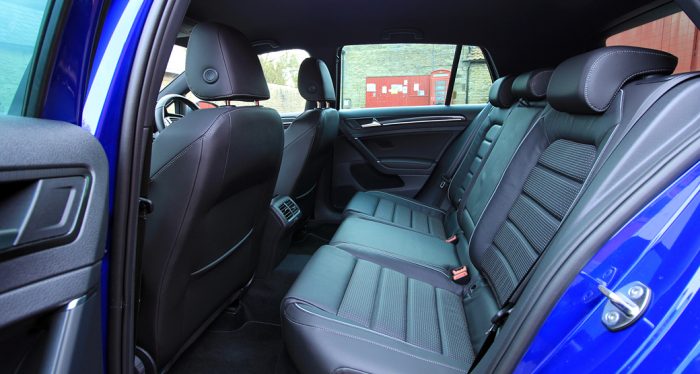
Up front, space is generous, and while rear accommodation is limited—as expected in a compact hatch—it’s livable. Boot space is compact too, but the rear seats fold flat, offering decent practicality when required.
Fuel economy is decidedly poor. When I picked up the keys, the trip computer read 22mpg, but I managed nearly 29mpg despite revving the hell out of it. Still, the Golf R isn’t defined by fuel economy, boot space, passenger room, tech toys, or button placement. These are minor quibbles.
Ultimately, real entertainment comes from behind the wheel and how connected you feel. And here’s the problem: you don’t feel particularly connected to the Golf R. The electronic steering dilutes engagement, leaving the car feeling unresolved. Yes, the lunatic speed allows for old-fashioned hell-raising—but it feels artificially induced and oddly unrewarding.
Overproduced. Like a Milli Vanilli vocal.